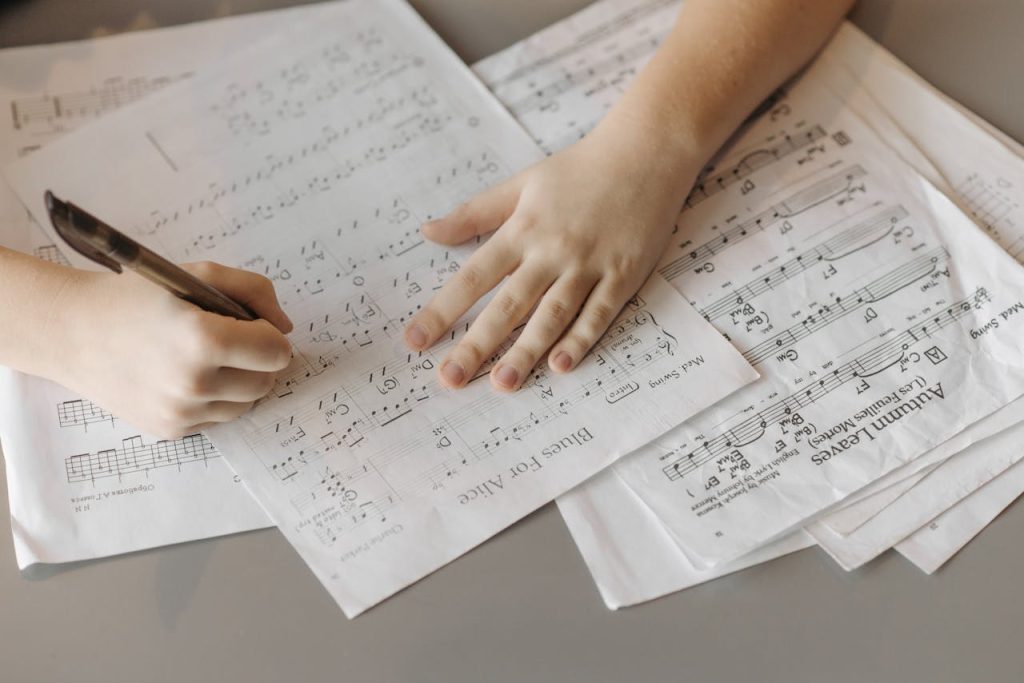
Many piano students believe that music theory is a separate subject—something in a workbook, far away from the pieces they are learning. But the truth is something very different.
Music theory is already inside every piece of music you play.
The moment a student sits at the piano and plays even a simple melody, theory is already happening.
Every Melody Tells a Story
Take a simple five-finger melody. It may look easy, but inside it you will find:
- Scales shaping the melody
- Intervals creating motion and emotion
- Rhythm patterns giving it life
- Harmony supporting the melody
When students realize this, something magical happens: theory stops feeling like memorization and starts feeling like a tool for understanding music.
Why Students Struggle With Theory
Many students struggle with theory because they learn it in isolation. They might complete worksheets about major scales or intervals, but they don’t see how those ideas appear in the music they are playing every week.
Imagine learning grammar without ever reading a story. It would feel disconnected.
Music is the same.
The “Aha” Moment
One of my favorite moments as a teacher is when a student suddenly notices something.
They might say:
“Wait… this looks like a C major scale!”
Or:
“This chord sounds like the ending of my other piece.”
That moment is when theory becomes real.
Suddenly the piano keyboard stops looking like 88 random keys and starts to make sense.
Why Theory Makes Pianists Better Musicians
When students understand theory inside their music, they begin to:
- Learn pieces faster
- Recognize patterns instantly
- Memorize music more easily
- Play more musically
Instead of reading note by note, they begin to see the structure of the music.
Music Is a Language
Just like language, music has its grammar, vocabulary, and patterns.
But the best way to learn a language isn’t through memorizing rules—it’s through speaking and experiencing it.
The same is true for piano.
Theory isn’t separate from music.
It is music.
And every piece a student plays is another step toward understanding the language.